by Hailey M.
December 3, 1964
It is after 4:30 a.m. The bus pulls up to Santa Rita Jail in Dublin, California. It has taken us about thirty minutes to get to this rundown building from Berkeley. By us, I mean the 800 other people arrested for our protests. We are marched inside the jail; it looks even more disgusting inside. We keep walking through the corridors. I am going to the cells. I cannot stop realizing how much I have changed. Four months ago I would never have been arrested, I would have never run away from home, and I would never be protesting. My parents have always looked down on women who voice their own opinions.
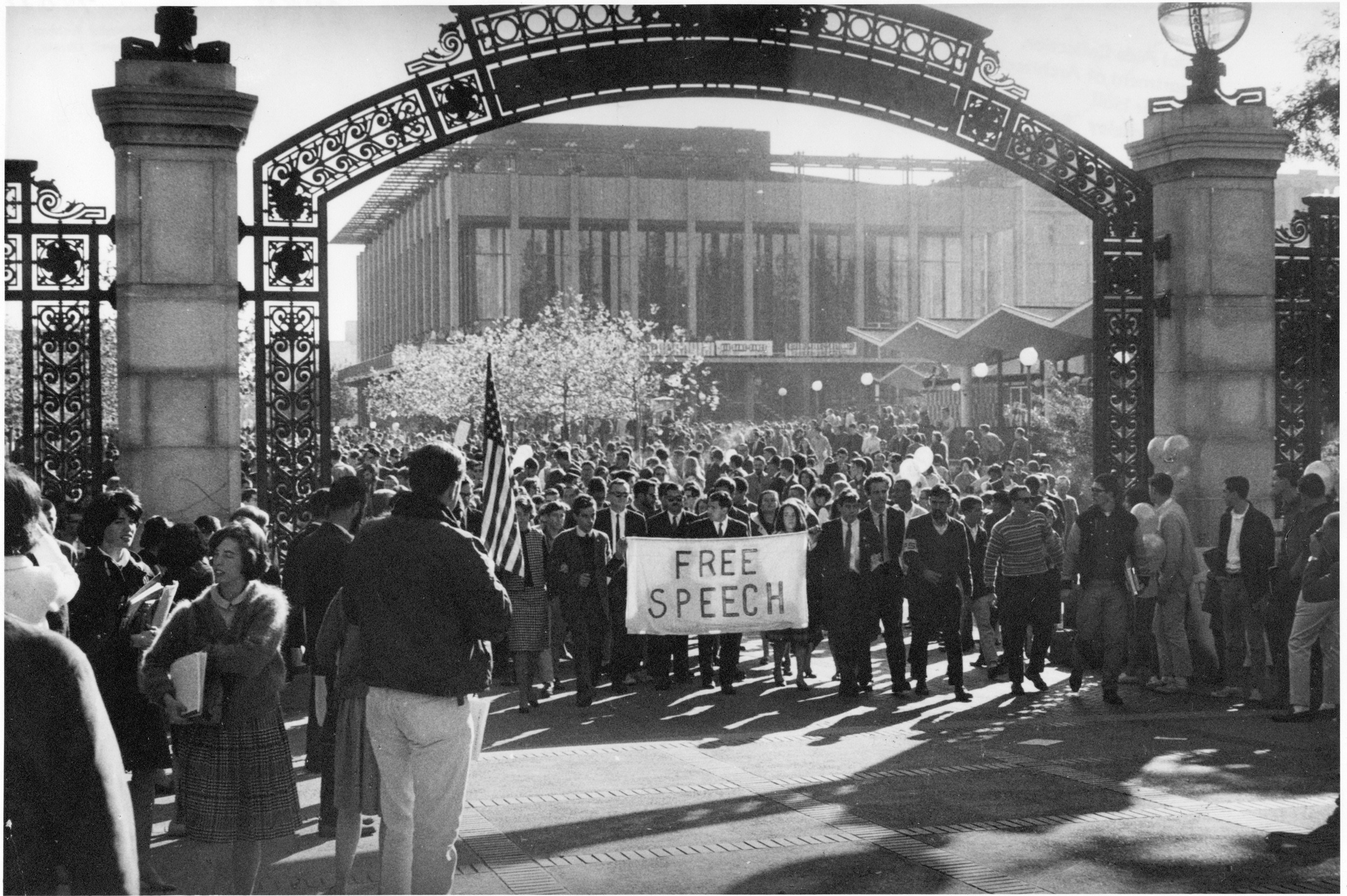 |
| The Free Speech Movement at Berkeley |
Suddenly, I feel hands grab my back and thrust me into a cell. I hear the door click shut. The cell is small. I have never been cramped in a room of such small space. The cell is smaller than my bathroom. At home my room is quite large — four times the size of this measly cell. The cell smells awful. There is no way to describe it other than vomit. The bathroom is even more foul. The bars are painted light gray, but the paint is peeling off. The walls are made of stacked cinder blocks, and the floor is cold concrete with dirt. I hear screams from other prisoners echoing in the halls. I am not screaming or saying anything. I am too stunned to do anything, so I sit on the ground against the wall. How could I have done this? Where did I go wrong? How have I lost myself so much? I do not know what else to do, so I begin to cry.
“You’ve never been to jail before, have you?” I turn to my right, where the voice came from. I am so distraught, I didn’t even realize there is another person in here. I see a young man no older than I; he looks a bit over twenty. His long, light brown hair is pulled back with a leather head band. He looks friendly. He tries again because he did not get an answer out of me the first time: “My name is George. I assume you have never been to jail before. You all right?”
I don’t know what to say. Should I answer him? But he is a stranger. I will answer, but how? I touch my wrist for reassurance, feeling for my bracelet. It is not there; I remember I took it off.
“My name is Jean — oh no, well, it used to be Jean, but now it is Paisley,” I reply timidly. “I don’t think I am all right. I don’t really know how I should be acting.” I never thought I would be this open with a stranger. This is not right, but George seems so nice.
“What do you mean your name used to be Jean?” George says sweetly. I should trust him. I do not have anything else to lose if I do not trust this boy. I decide to confess my story. I need to tell someone. I have held it in for so long. I need to talk to someone, not as Paisley, but as my real self, Jean. So I begin my story.
*****
It all started a little over three weeks ago. On Wednesday, November 11, I arrived home from my classes at Berkeley, which was at about 5:30 because my classes ran late. I parked my little VW bug in the driveway and went straight to the mailbox to see if I had gotten any mail. I opened the mailbox. I was surprised when I only saw three letters in there because normally we get at least ten. I shuffled through them: one from Aunt Sue, a flyer for Coke, and a letter from the Defense Department. Shocked by the final envelope, I immediately ran inside. I handed my father the letter with a worried look on my face. I began twisting my bracelet about my wrist.
The first thing he said to me when I handed him the letter was, “It is not becoming of a lady to run.” Then he opened the letter. As his eyes scanned the letter, a worried look appeared on his face. Father said, “Betty, come over here. It’s about John.” Betty is my mother and John is my brother, who was off in Vietnam fighting the war. I remember my father looking away from me and my mother, but not before I saw some tears running down his face. I had never seen my father cry before. Father is very strong and unemotional, so I knew something terrible must have happened to John. I was afraid to ask what happened because I knew that I would not want to hear the news. If Father started crying, then I could not imagine how I would react. I could not take the suspense. I had to know about John.
“Father, can you read the letter?” I asked timidly, not knowing how he would react in such an emotional state. Then he started reading the letter that would change my life. The tone of Father’s voice was so fierce. There were only a few other times when I had found him so intimidating, such as when African Americans were demanding more civil rights. The angriest I had ever seen Father before that was when Cassius Clay converted to Islam and changed his name to Muhammad Ali.
I do not remember any sentences from that heart breaking letter, other than the first line: “We are sorry to inform the loved ones of John Doherty that while in action, he received a fatal injury.” I did not hear the rest of the letter; my mind was repeating over and over, he received a fatal injury. I stood still for a few moments, not knowing how to react, just standing there numbly. Without saying anything, I stood up and exited the room. I walked down the hall to my bedroom. When I got to my bed, I crumbled and cried for hours. My brother had been my best friend. The person I had been closest to. The person I had told everything to. The only person whom I had fully trusted.
He taught me things. John made me see life differently. He taught me the unfairness of racism. I never really had a opinion because it did not affect me, but he tried to stop racism. John thought it was awful. He showed me my second favorite musician after the Beatles, Louis Armstrong. John showed me Jackie Robinson. He was so excited because he thought that segregation and racism would finally end.
I was devastated the day his number was picked for the draft, but I got through it. I got through it with hope that he would come back, but my hope did not save John. At that moment in my room, I knew I would look at life through a whole new set of eyes. I would not be cheerful Jean who pleases everyone, but now a sorrowful girl. I then decided that I no longer wanted to stay at home, not just then but ever. I decided to run away. Without John around, I did not want to be near anything that would remind me of him. I would run away from that house, that family, that lifestyle and that person. I never could be Jean again. I realized something: I don’t belong in this society, not without John. I don’t want to be reminded of him.
*****
Early the next day, I grabbed some of my clothes and shoved them in a bag. Next, I found a piece of paper and a pen. I started to write:
Mother and Father,
I am sorry, but I cannot stay here any longer. I must go away; I don’t belong.
Much Love,
Jean
I left the note on my bed and scampered down the hallway, out the door and into my blue VW bug. The song “A Hard Day’s Night” by the Beatles started playing; it calmed me down. It is my second favorite song, after “I Want to Hold Your Hand.” I love the Beatles! Paul McCartney is my favorite; he is extremely attractive.
I pulled up to a white wooden house, my cousin Helen’s house. I knew I had nowhere else to go. Helen had been my friend when I was twelve, but I had not really spent time with her since then. I parked my car in the double driveway and made my way to the door. There was a sudden pain in my wrist that caught me by surprise. I tried to take my bracelet off, but the clasp was stuck. I finally reached the door and I knocked.
“Can I help you?” a deep voice asked in a nonchalant tone. A young man answered the door. He had dark brown hair. He looked just like Paul McCartney! Paul McCartney was my love and I wanted to marry him. Whenever I mentioned that, Father always harshly told me that it is not a woman's job to select her husband.
The man at the door was holding a guitar in one hand. He looked kind, but not fully focused. I replied, “Yes, I am looking for my cousin, Helen.”
“Helen, your cousin is here to see you!” he shouted inside. “Come in.” I entered and noticed the living room on the left. The room was disastrous. It was so messy you would have thought that the 9.2 Alaskan Earthquake in March had hit here. There were four people in there. They were absorbed in painting something. The were painting the letters “FSM” on a cloth. I understood what that meant immediately: the Free Speech Movement. Helen was involved with that pointless protest. Then, one of them looked up; it was Helen.
“Jeannie! I haven’t seen you in ages! I see you have dropped the flowy jumper style,” she said while hurrying over to greet me. I noticed that she looked different, too. She was wearing a leather vest covering a little of her body and long flowy pants. Her hair was a long wild curly mess. In her hand was a pipe filled with marijuana. Helen smoking marijuana? Wow! She had changed a lot.
Helen noticed me gazing at the pipe, so she offered, “Do you want to try?” I politely declined and told her the story of what had happened with John and my running away. During the story I was constantly fidgeting with the bracelet clasp, and finally it came off. I put it in my purse. Helen teared up a little, but then wiped her tears away. Quickly composing herself, she comforted me by offering, “You can stay with us for awhile.” I accepted, first because I had nowhere else to go, and second because I knew that they were hippies and they didn’t belong in society either. They could distract me from my mourning for John. Then Helen introduced me to her friends: Stephen, the boy who had answered the door, Opal, Janet, and Mario.
I knew that I would not be accepted with her hippie friends if I were plain, goody two shoes Jean, so I changed my name. I was then Paisley, a fearless hippie.
*****
During one of my first breakfasts with the hippies, I found Helen and her friends having a heated debate about the next step of the protests. When I went downstairs, after their thirty minutes of arguing, they asked me my opinion. I wanted to fit in with them, so I replied and told them I too believed in the Free Speech Movement, even though I did not feel the same way. I explained that if we were going to get the university to change, we needed to be persistent, holding sit-ins as often as possible. At the time, I was pleased with what I said because it would allow me to be a part of something, anything to make me forget about losing John. Then every morning they asked me about my opinion, and every morning I lied about what I thought. I began to dread breakfast and telling those lies.
Slowly I began to be more like them. I strived to fit in with the hippies. First, I started wearing outlandish clothes, and then I started believing in their views. This led to doing drugs, and joining the protests. I started to believe those lies I told at the breakfast table, but I could never be as passionate about the protests as they were.
I walked by the protests at Sproul Hall every day on my way to classes, but I never understood their motives. I thought it was a waste of time and nothing would change. Father told me that they were over-privileged kids who thought that they could change the world. The more time I spent with the hippies, the more I realized how wrong Father was. Students have the right to free speech and expression of their political views, so Berkeley didn’t have the right to prevent them. We were all being restricted by the university. I began to understand what the hippies were doing and why, but I did not want to change the university.
Later I found out that Helen’s friend Mario was Mario Savio, one of the leaders of the movement. Helen was actively involved in the planning of the protests, so I got involved, too.
*****
December 2, 1964
The university decided to prosecute some of the leaders of the Free Speech Movement. Helen, Mario, Stephen, Opal, Janet and I were joining others to protest the prosecution.
I sat on the steps of Sproul Hall, waiting for the rally to start. I saw Mario stand up and move towards the front of the crowd, to the podium, where began his speech:
“We have an autocracy which runs this university. It’s managed. We asked the following: if President Kerr actually tried to get something more liberal out of the Regents in his telephone conversation, why didn’t he make some public statement to that effect? And the answer we received — from a well-meaning liberal — was the following: He said, ‘Would you ever imagine the manager of a firm making a statement publicly in opposition to his board of directors?’ That’s the answer! Now, I ask you to consider: if this is a firm, and if the Board of Regents are the board of directors, and if President Kerr in fact is the manager, then I’ll tell you something: the faculty are a bunch of employees, and we’re the raw material! But we’re a bunch of raw material that don’t mean to have any process upon us, don’t mean to be made into any product, don’t mean to end up being bought by some clients of the University, be they the government, be they industry, be they organized labor, be they anyone! We’re human beings!”
The audience erupted in applause. I started to think. I did not believe what he was saying. We were not raw material. We were students. I was not passionate about changing this university; I only wanted to learn.
“There is a time when the operation of the machine becomes so odious, makes you so sick at heart, that you can’t take part; you can’t even passively take part, and you’ve got to put your bodies upon the gears and upon the wheels, upon the levers, upon all the apparatus, and you’ve got to make it stop. And you’ve got to indicate to the people who run it, to the people who own it, that unless you’re free, the machine will be prevented from working at all!”
During this whole segment of the speech, I was questioning myself. Why did I become involved in this battle for student freedom? We are free students!
“Now, no more talking. We’re going to march in singing ‘We Shall Overcome.’ Slowly; there are a lot of us. Up here to the left — I didn’t mean the pun.”
Then we sang. I began to sing as well, not knowing what else to do. The students stood up and marched into Sproul Hall. I followed, not wanting to be left out.
We were with 800 other people sitting in Sproul Hall after the rally. It was the only way we could demonstrate to the administration that they were wrong to single out a few people to arrest. I spent most of my time on the second floor, watching movies. Janet and Opal were on the fourth floor, which was a study hall. I was relieved by the orderly manner of the sit-in; it was not at all like what Father said protests were like. Sitting next to Helen, we watched Mary Poppins, The Unsinkable Molly Brown, The Carpetbaggers, and It’s a Mad, Mad, Mad, Mad World, which were some of my favorite movies. The more time I sat with Helen, the more I realized how much I had missed her over the years.
At about 3 A.M. on December 3, the administration urged us to leave Sproul Hall. Not many people left, if any. We wanted to defend the people who had been arrested. I sat still till about 3:45 A.M., when police came charging in. I was so frightened as their thunderous footsteps marched up the stairs. As I felt my wrist to get comfort from my bracelet, I realized it was gone. Students began to disperse and run around, but they did not get very far. I saw Helen run out of the room. My eyes gazed around the floor to find her, but she was not there. Then, hundreds of police stormed the room, seizing everyone they could. It was total chaos. I moved towards the wall, hoping not be noticed, but it was pointless. An officer clutched the collar of my shirt and began to haul me off the ground. He told me to stand, and I did, terrified of what might happen next. The officer held my arm strongly and marched me out of the room. Thirty protesters were gathered in the hall. Officers were surrounding us and began to push us down the stairs. I frantically began to search for Helen again, and I still could not find her. Then I searched the crowd for Stephen and Opal and Janet, but I couldn’t find them either. I started to scream Helen’s name; there was no response. I guessed that she probably couldn’t hear me over the ruckus. I trudged down the stairs with the rest of the captives. We were marched out the door and onto a bus. On the bus I searched for Helen, but still she was not there. I hoped she had gotten away, so she would not be sent to prison like the rest of us.
“How are we going to fit 800 of the hippies in four buses? Will we have to take multiple trips?” I heard an officer question. Wow! There were 800 protesters. I saw about 500, but I would never have imagined so many passionate about one concept. Suddenly, I was forced into a seat with three other people. Our bus drove away.
I kept thinking, How could I have done this? How have I gone this far astray? I want to go home. Then I reminded myself, I changed. I am a different person. Not Jean, but Paisley. Paisley should not be nervous to be arrested. I should embrace it. Somehow I could not make myself proud that I fought for what I believed in. I spent the whole half-hour bus trip questioning myself.
*****
December 3, 1964
I finish my story and take a second to think.
“So you never were passionate or fighting for what you believed. You were just trying to be a different person.”
“You’re right. I was so fixated on being different, on changing, that I got way too involved. I got involved in a protest I didn’t even care about, and I got arrested for it. I don’t recognize myself anymore. I am not Jean, yet I am not Paisley, the girl I strived to be. I am a follower and an idiot. How could I have gotten arrested? What have I done? I did not belong with the hippies; I was only following.” I reach into my bag to find my bracelet and take it out. I begin to clip it, but the clasp is broken. “I cannot be my old self again, and I cannot be Paisley either. When I am released, I will go home and become a different person, a better one.”

I really liked how you had the bracelet as a symbol through out the story (how in each scenario it symbolizes the state of her life; at the beginning it is with her and not broken & she is who she is, and how at the end it is broken but she has it & she isn't who she wanted to be but wants to make her life unbroken). Also, I think that her emotions through out the story were really well written and described!
ReplyDeleteI liked how at the end you made your character realize that she was going to be a different person. And how she couldn't go back to being just Paisley or just Jean.
ReplyDeleteI love how the bracelet symbolizes Jean's change into Paisley and how she realized she couldn't just be the same person again. I also really like all of your characters' names. Great story Hailey!
ReplyDeleteI like how she becomes a very classic hippy when at the beginning she is very opposed to it. i also like the whole part with the bracelet and how it symbolizes the change in Jean/Paisley's personality.
ReplyDelete-Nick M.
This story is great Haley! I love Jean / Paisleys journey. I think it was really interesting how she didn't believe what she was protesting for but, she did it anyway. Great Job!
ReplyDeleteParker Gioia