by Elise F.
June 6, 1939, 11:26AM
He watched the St. Louis from a Coast Guard cutter, which looked small by comparison. The boat carried over nine hundred German Jews hoping to enter the United States. His job was to prevent it from reaching Florida’s coast. Well, not exactly. The water near the shore was too shallow for it to get very close, so the passengers would have to go the rest of the way in life boats, a time consuming operation with a risk of many people not actually making it to the shore. The ship would have to reach a harbor in order for its passengers to disembark safely, so really his job was to keep it on course and prevent any desperate passengers from jumping overboard and trying to swim to the shore. Hopefully by the time the St. Louis reached its destination, the Coast Guard would have the proper legal documentation to allow the immigrants into the country. If the passengers were not allowed to enter the United States, they would have to return to Europe. In Europe they would be very close to the people who would go to great lengths to make sure they died.
June 6, 1939, 5:43PM
“The order just came through. We’re supposed to keep them away from the coast. They won’t be allowed to enter the country.”
He was shocked. The ship would have no choice but to leave the United States and return to Europe. “They’ll be killed, and it will be all our fault,” he whispered.
“You didn’t give the order, so it’s not your fault. You have no other choice,” a third person added, passing him copy of the handbook. The man didn’t have to open it. They all knew every line of the Coast Guardsmen Creed. And they all knew which one he meant.
I will cheerfully and willingly obey all lawful orders.
“Are we sure it’s lawful to send nine hundred innocent people to their deaths?” His tone was almost threatening.
“You can blame all the politicians. If we don’t do it, they’ll just find someone else. If you don’t do it, the next guy will. The politicians control everything. If they say there’s no solution, no one’s going to try to find one,” the third person responded.
“Less talking, more working!” the first person butted in. “The faster we get done here, the sooner I collect my paycheck and get home! Surround the ship. Stay where the passengers can see you. Make sure they see that we’re in control. I want to get this over with as quickly as possible.”
He watched the St. Louis from a Coast Guard cutter, which looked small by comparison. The boat carried over nine hundred German Jews hoping to enter the United States. His job was to prevent it from reaching Florida’s coast. Well, not exactly. The water near the shore was too shallow for it to get very close, so the passengers would have to go the rest of the way in life boats, a time consuming operation with a risk of many people not actually making it to the shore. The ship would have to reach a harbor in order for its passengers to disembark safely, so really his job was to keep it on course and prevent any desperate passengers from jumping overboard and trying to swim to the shore. Hopefully by the time the St. Louis reached its destination, the Coast Guard would have the proper legal documentation to allow the immigrants into the country. If the passengers were not allowed to enter the United States, they would have to return to Europe. In Europe they would be very close to the people who would go to great lengths to make sure they died.
*****
June 6, 1939, 5:43PM
“The order just came through. We’re supposed to keep them away from the coast. They won’t be allowed to enter the country.”
He was shocked. The ship would have no choice but to leave the United States and return to Europe. “They’ll be killed, and it will be all our fault,” he whispered.
“You didn’t give the order, so it’s not your fault. You have no other choice,” a third person added, passing him copy of the handbook. The man didn’t have to open it. They all knew every line of the Coast Guardsmen Creed. And they all knew which one he meant.
I will cheerfully and willingly obey all lawful orders.
“Are we sure it’s lawful to send nine hundred innocent people to their deaths?” His tone was almost threatening.
“You can blame all the politicians. If we don’t do it, they’ll just find someone else. If you don’t do it, the next guy will. The politicians control everything. If they say there’s no solution, no one’s going to try to find one,” the third person responded.
“Less talking, more working!” the first person butted in. “The faster we get done here, the sooner I collect my paycheck and get home! Surround the ship. Stay where the passengers can see you. Make sure they see that we’re in control. I want to get this over with as quickly as possible.”
*****
He entered the building with several other volunteers. In his hand he held a copy of a newspaper ad he had filled out and sent in to a “Professor Stanley Milgram” to participate in a study on memory. Upon arriving in the waiting area he was asked to sign in and then handed a check for $4.50, his payment for participating. As he sat down to wait, he ran his thumb across the writing, smudging the last two digits of 1961. But it didn’t matter, because he could still see the date, and because he didn’t think anyone really cared anyway. As he carefully pocketed the slip of paper, someone else entered the room. This man looked to be in his fifties, with graying hair and round glasses. The newcomer offered a friendly smile before taking a seat next to him and picking up a newspaper to read. “Would you look at that!” the newcomer exclaimed, pointing to the headline. “‘The Adams Express Robbery. Trial of the Alleged Robbers at Bridgeport, Connecticut.’” The newcomer seemed to be expecting a response, so the man just nodded, slightly wary of this somewhat unseemly character.
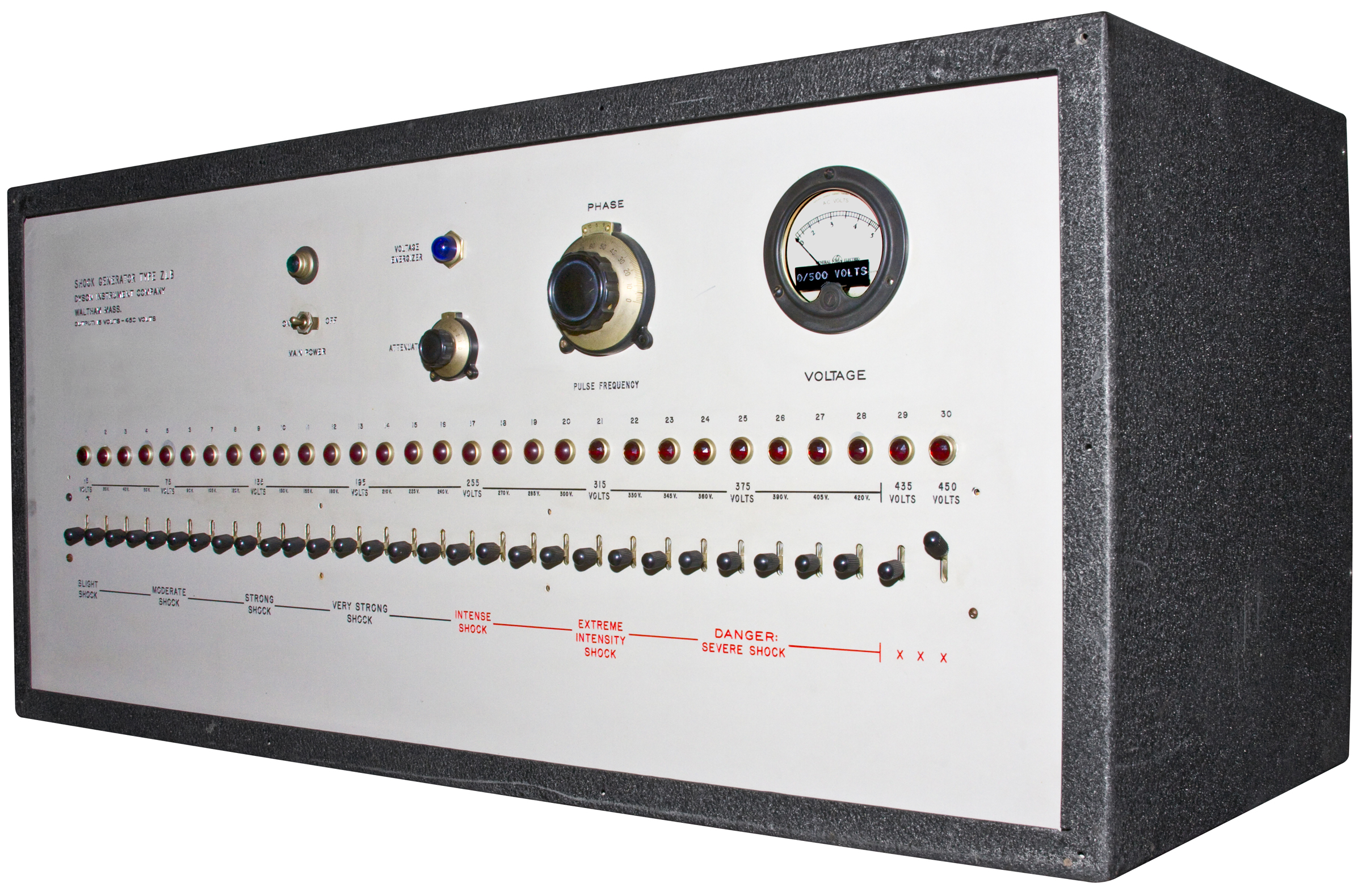 |
| The machine from the Milgram shock experiment |
There was an awkward pause as the man tried to think of something to say to break the silence. Finally, he just asked, “Any idea what they’re going to have us do?”
“Not a clue. The pay is good, though,” the newcomer shrugged. “It would take me three times as long to earn this much money on a normal day.” His voice was cheerful, and he smiled again. He seemed a bit too happy, but the man found himself grinning anyway.
“Yes, I’m getting paid more to spend an hour here than to spend a full day at work. Why do you think that is?”
The newcomer shrugged again. “I guess people get suspicious of experiments that involve human test subjects. They need to make it worth it for us to take the risk.” He stuttered slightly, but quickly regained his composure. The man was about to ask what the newcomer meant when a tall man in a white lab coat pushed the door open and walked briskly over to them.
“This is a study of the effects of punishment on learning and memory,” he spoke crisply. “Please choose one.” He held out two slips of paper so neither of them could see what was written on them. The man took the slip closest to him. “It says ‘teacher,’” he told the experimenter.
“Then you are the learner,” the experimenter told the second man. “Please follow me.”
The experimenter took them back into a small room with only a desk and a chair. The chair had restraints on the arms and wires attached to the feet; it looked like something out of a horror movie. The experimenter told the learner to sit down and fastened the restraints firmly around his wrists. The experimenter then told him how the experiment would work. “You will be given a list of word pairs to memorize. Then you will be given a word and four options to choose its match from. If you choose the correct match, you will proceed to the next pair. If you answer incorrectly, you will be given a small electrical shock. The shock will increase with each incorrect answer. We will begin the experiment in exactly five minutes.” He turned abruptly back to the first man, as if just remembering he was there. “Follow me, please.”
The experimenter turned on his heel and strode out of the room, the man hurrying to keep up. The man followed him into the next room over, and the experimenter closed the door behind him. The man froze, struck by the contrast between this room and the last. The soft light danced across the light green walls and illuminated a wooden desk covered with files. The walls were decorated with various pictures, the largest of President Kennedy. The only thing that seemed out of place was a large black and gray machine sitting against the wall on a second desk.
The experimenter walked over to it, and the man followed cautiously. “You will be reading the word pairs to the man in the next room,” the experimenter continued in a dull monotone. “Here is the complete list of word pairs. You must speak clearly into the microphone so he will hear you.” The man nodded. The experimenter gestured to several small lights on the front of the machine. “These lights indicate the subject’s response. If he responds correctly, continue to the next set. If he responds incorrectly, use these switches here to deliver an electrical shock. The initial shock is set at fifteen volts. Increase the electrical current by fifteen volts for each incorrect answer. We will begin as soon as the subject’s allotted time to memorize the word pairs is up.” With this, the experimenter walked back to the cluttered desk and began to sort through files, seeming hopelessly optimistic about the experiment.
Unsure of what to do, the man sat down at the table and began to examine the shock generator. There was an inscription in the top left corner of the large metal box that read, “SHOCK GENERATOR TYPE ZLB, DYSON INSTRUMENT COMPANY WALTHAM, MASS, OUTPUT 15 VOLTS-450 VOLTS.” Below various dials was a row of red lights followed by a row of black switches. He looked down at the sheet of word pairs and began to read through them to avoid looking at the evil thing in front of him.
A little girl leaned over the railing of the ship. She looked to be about six years old and held a doll to her chest. She smiled, and lifted her doll’s arm to wave at him. He glanced cautiously at the men around him. None of them seemed to notice the girl, and he did not know whether to wave back, so he looked down and pretended to be adjusting the gold buttons on his Coast Guard uniform.
The experimenter looked up from his desk. “Five minutes are up. Please begin the experiment.” The man turned on the microphone.
“Uh...hello?” the man began.
“I can hear you,” the subject responded.
“Okay.” He glanced down at the first set of words. “The first word is laundry. Is the match shirt, shoes, socks, or tie?” The man stared nervously at the little lights for what seemed like an eternity. The third light came on, and he breathed a sigh of relief. “That is correct.”
After several word pairs, the man started to grow comfortable with the process. Every answer had been correct so far, so his job was fairly easy. They were on the fifth pair. He waited for the fourth light to come on, but the second one came on instead. He froze. “I can’t do this,” he told the experimenter.
“Please continue,” the experimenter coaxed.
“Stay where the passengers can see you. Make sure they see that we’re in control.”
“Sir, the experiment requires you to continue.”
“If you don’t do it, the next guy will.”
“That was incorrect,” he muttered. He flipped the first switch. There was a loud buzzing noise as the shock generator burst to life. He heard movement in the next room but no complaint from the subject. He read the next pair. Incorrect. The experimenter saw his hesitation and spoke up again.
“It is absolutely essential that you continue.”
He moved to thirty volts and flipped the switch. This time the buzzing was followed by a soft grunt from the next room. “Are you sure this is safe?”
“You will not be held accountable for anything that happens during this experiment.”
“You didn’t give the order, so it’s not your fault.”
“Yeah, but are you sure it’s safe?”
“You have no other choice. You must go on.”
“You have no other choice.”
“Sir?”
“The politicians control everything. If they say there’s no solution, no one’s going to try to find one.”
The man was frozen in place. He could feel the sweat trickling down his neck. The light he had once found calming was blazing hot, beating down on him like a spotlight. The walls seemed to be closing in. He was trapped. The pernicious machine glared down at him, daring him to make a choice.
“Are we sure it’s lawful to send nine hundred innocent people to their deaths?”
“I won’t,” he whispered. He looked up, surprised. He had found his voice. “I’m not doing this,” he spoke with more confidence now. “I’m sorry, I’m just not.”
There was a long pause. The experimenter watched him, as if checking to see if he was sure. Then the experimenter left the room, and the man was alone. Alone, and finally free.
More from this author...

I really enjoyed your story! I thought that going back and forth between the two stories was a cool idea. Also, your description of the characters' actions were very vivid and clear (e.g. "As he sat down to wait, he ran his thumb across the writing, smudging the last two digits of 1961.")
ReplyDelete