by Caroline Ja.
“Kenneth!” A voice echoed down the hallway.
“Kenneth!” Heavy footsteps got closer.
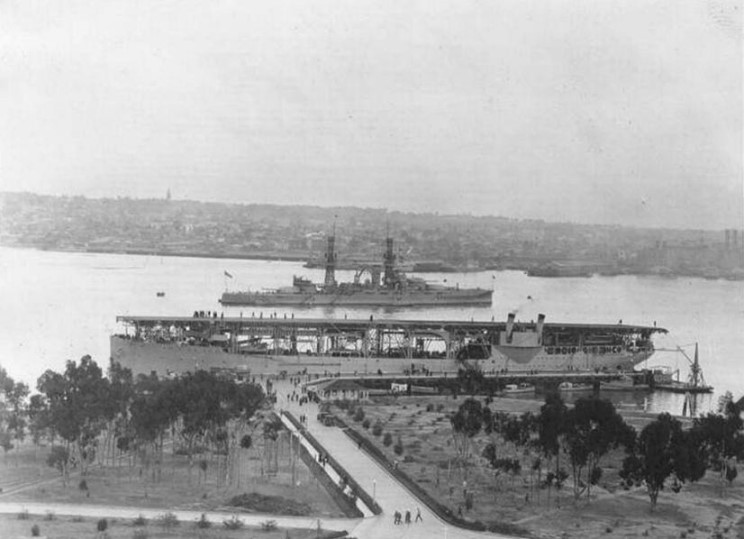 |
| The U.S.S. Arizona, before the attack |
“Kenneth! Get up! The Reds are losing and I need twenty-five cents for James if they’re beat! KENNETH!” The handle on the metal door made a rattling sound, closely accompanied by an ear-splitting, rhythmic banging of someone kicking it. A moan of protest came from inside.
“It’s Sunday for God’s sake, Robert! I was asleep! Go get your own twenty-five cents.”
“You can’t lock me out! We share a room!” A pause. “Come on, Mister High-And-Mighty, and let me in.”
“No!”
There was a sigh of defeat from the hallway and the heavy footsteps receded. Inside the small room, Robert’s roommate Kenneth rolled out of bed.
Kenneth was one of over 1,500 men stationed on the U.S.S. Arizona, spending his days onboard while it was stationed at Pearl Harbor. He lived and breathed the sea. It wasn’t unpleasant. For December, Hawaii was extremely warm, and a radio onboard the ship broadcast music and baseball games from a radio station in Honolulu. Robert had taken to betting on the games with other crewmembers. He almost always lost, and was always coming to his boyhood friend Kenneth for money.
Kenneth finished tying the loose navy blue tie around his neck and hefted the baseball bat Robert and he shared. Some of the boys from the Arizona would go to the air force base, as they always did on Sundays, to play a spirited game of baseball with some of the pilots at around 8 o’clock. Sunday was everyone’s day off, when some people got lifts into Honolulu or stayed at the base. Kenneth was one of the latter. The Arizona was his home, and he loved it as such.
The radio was on just below decks, blaring stats from the most recent baseball game: “...And the Cincinnati Reds are down 7-0, folks, that’s the most we have seen them losing by for a long time… the home team, losing horribly to the Phillies… and a team with a record like the Reds…and now we take a break for the weather in Honolulu. December 7th, looks like it’ll be a fairly warm day, right now it’s 7:50 a.m…”
Kenneth got above decks to see some sailors leaving the ship, playing baseball on the pier, heading downstairs to listen to the baseball game, or carrying around bits of breakfast with them. A group of seven was even singing along hoarsely to a banjo one of them had brought onboard, while one pretended to dance the Jitterbug with a nurse who was visiting. Some just lounged on the deck or ran foot races around the bow and the massive gun turrets. Dozens of black specks grew closer on the horizon: planes. Pearl Harbor, being a Naval and Aircraft Base, saw a lot of planes. No one paid them any attention. Kenneth didn’t think anything of them, either. They were just silhouettes, some of the pilots doing runs even on Sunday.
Kenneth found Robert near the bow, preparing to race George Hunt and James Bavern to the other end of the massive battleship. A crowd was gathering; Robert and James were two of the most reputed runners on the ship. One of the sailors held a whistle, ready to blow, in three, two…
“What is that?” George Hunt asked suddenly, getting up from his starting position. Sailors turned their heads. Some of the planes that had been approaching were flying lower than they should have been, no more than a few hundred feet over the water.
“Someone’s showing off,” Robert brushed aside George’s worries.
More and more of the planes were starting to swoop lower and lower. From the Arizona’s position on Battleship Row, Kenneth could see sailors on other ships and on Ford Island turning to look at the planes.
Something black fell from the bottom of the lead plane as it tilted its wings upward and the sunlight flashed across the red and white symbol on the underside of its wings: the Japanese Rising Sun.
The black object -- a bomb -- exploded and destroyed a dock. The people who had seen the Rising Sun started running to their posts. Most sailors looked confused, as if they couldn’t comprehend what the planes were doing. With the sun behind the planes, they were like twisting silhouettes. The crewmen who had been playing baseball dropped everything and ran to their ships. The radio shut off and everyone rushed above decks as more bombs exploded. Sirens started blaring and the Japanese planes opened fire with machine guns as American pilots on Ford Island rushed to man their planes and sailors ran to their ships.
Captain Valkenburgh rushed above decks. Even hurrying, he had a commanding presence that demanded attention. Sailors snapped to attention, but the Captain yelled, “Don’t stand there looking like pretty idiots! Air raid! To your stations! This is not a drill!”
Men ran to anti-aircraft guns and mounted the turrets. The Japanese planes zoomed overhead, spraying the deck with bullets, bombs dropping off the port side. Kenneth and Robert split to go to their different stations: Kenneth to the bridge of the ship, Robert to guns on the bow. After drills and drills doing the same, Kenneth’s mind went on autopilot, mounting the several story tripod bridge and joining other crew members at the top.
Kenneth wasn’t given much time to think, but his brain still managed to reel out questions. Of Japanese relations with the United States, Kenneth didn’t know much, but he was certain that the Japanese ambassador was holding peace talks in Washington. Yes, he had heard it on the radio just yesterday. Yesterday. This attack must have been months in the planning, weeks in execution; had those debates in Washington been a ploy? Had the Japanese led the Americans on while they had moved in secretly to attack? Kenneth had never particularly like the native Japanese -- they had killed thousands of other men in their conquests in China -- but he was starting to downright loathe them.
“God almighty, they’re aiming for for us!” someone cried, though who the man was yelling to Kenneth wasn’t sure. From his high mount above the harbor, he could see the planes more clearly, underwater torpedos spinning toward battleships, planes at the airbase smoking. Battleship Row, a deep channel off of Ford Island, was where the United States’ nine battleships were moored. All save one of the battleships were accounted for. Second in power and cost only to aircraft carriers, the battleships would be the target of the Japanese.
From the bridge, Kenneth could see men struggling on deck. The guns and the ammunition were both padlocked to avoid sabotage. The Arizona was a sitting duck: unable to fire, unable to move.
One of the six other sailors on the bridge seemed to be thinking the same as Kenneth: “We just refueled yesterday! Get her moving!”
“We can’t! We’d either hit the island or the Vestal!” another man protested, pointing out the smaller repair ship docked between the Arizona and the open water.
“The ammunition’s locked up, sir; we can’t fire back!”
Kenneth looked out over the double row of battleships. One, possibly the Nevada, launched a projectile from one of its turrets at a plane. It fell short. The planes were too high for the battleships and anti-aircraft guns to reach, and too fast and unpredictable when they dove to hit without a large dose of luck. No American planes were in the air. No ships were moving.
Five Japanese planes flew in formation over Battleship Row, ready to release their cargo. Bombs fell toward the Arizona. Kenneth saw two miss and another bounce off Turret 3 and fall below decks; it detonated with a blast that made the ship rumble. Flames rose from below decks and panicked sailors ran to combat them. Too few posts were manned. Too little ammunition was available. Near the Arizona, the West Virginia tilted sickeningly to the side. Nothing good was happening there.
Several seconds later, the only thing Kenneth saw of the final bomb was a streak of black hurtling past the bridge and hitting the deck before a massive blackout of smoke engulfed the bridge, accompanied milliseconds later by a wall of fire. The whole ordeal was deafeningly silent; Kenneth couldn’t seem to hear the explosion, though whether it was the shock or the terror that blocked his ears he wasn’t sure. The whole ship heaved upward out of the water, dozens of feet, and then fell back down with the sound of wrenching metal. The bridge wobbled. The exterior protected the seven men inside from the wall of fire, but not completely. Kenneth could feel flames rushing over him; some parts of his body were flooded with pain, other parts were completely numb. Numbness had never hurt so much. He collapsed, shaking, and smoke billowed up inside and outside of the bridge.
“We’re sinking!” yelled one of the men who was less hurt. “Get off the bridge!”
“The stairs are too full of smoke! We’ll be burned or choked!”
“If we stay here we’ll be burned or choked anyway!” the first man yelled.
“What about the Vestal?” another man suggested desperately. “Could we get over to her?”
Someone grabbed Kenneth under the arms and hauled him up. “How’d we get a line over there? Can these guys even climb?”
Kenneth’s head swam. Two more men were lying on the ground. His skin was red raw and almost all daylight was blocked out by the smoke filling the air. The wind was starting to blow it away, but it was still thick inside the bridge. It may have just been his imagination, but the floor seemed to be tilting. “Can you get someone’s attention?”
His vision snapped in and rolled out of focus. He was vaguely aware of his crewmates shouting, something shattering, from either the heat or a heavy blow. The world was tilted and spinning in dizzying circles. How long his crew members remained shouting, he wasn’t sure. Three of the other men were sitting, resting and pooling their strength.
There was a cry of triumph and Kenneth’s vision focused again to see one of the standing men holding a thick line. Heads jerked up. “Tie it off!” someone yelled. “Get across! She’s gonna roll!”
Hands helped Kenneth up and to a broken window of the bridge. The repair ship Vestal looked a little worse for wear, but not nearly as bad as the Arizona. Smoke still billowed up with gusto, and the deck no longer looked horizontal to the water. His vision was too blurry to tell, but Kenneth didn’t think he saw anyone on deck. The bow looked completely destroyed. Robert had been at the bow when the bomb had hit. He wasn’t there now.
Two men went in front of Kenneth, hand over hand across the rope. They were dozens of feet above the oil-clogged water, but the bridge should have been higher; the Arizona really was sinking. But Kenneth wasn’t worried about drowning. The bridge, several stories in the air, wouldn’t sink to the bottom of 40-foot-deep Battleship Row. It was fire, and collapse of the bridge tripod, that some small, sane part of Kenneth was worried about. Japanese planes still whisked past, but they were irrelevant. All that mattered was getting across the rope, several dozen feet, to the Vestal.
Kenneth was weak, but adrenaline still ran through his veins. Hand over hand, terrifyingly slowly but steadily, Kenneth crawled across the line. Skin scraped off of his hands, arms, and legs. He could see crewmen on the Vestal running around, a couple on the bridge holding the line for the Arizona crewmen. The first man made it across. Hanging in the air, with bullets from Japanese fighters whizzing past, Kenneth felt vulnerable, like he was standing in the middle of a highway. Nothing protected him from the bullets of the Japanese or a fall of forever into the black water below; the only thing he could do was ignore the pain of his burns that ignited every time he moved, and to get across to the Vestal.
He didn’t realize that he had made it until a pair of hands grabbed him, yanked him off the line and lay him down on the deck. Vibrating footsteps like a herd of charging elephants resonated through the metal deck as Kenneth rolled and put his ear to it. A cloth was placed over Kenneth’s eyes, and the dark blinded him; hearing the sound of planes without seeing the danger wound him tighter than a spring. He didn’t notice the Vestal start to move, didn’t register the jolts of bombs, and had passed out by the time the ship had beached itself. He didn’t see his ship, the Arizona, which had been his home for years, settle under the water and fill the harbor with flames.
Two months later, Kenneth was back in the States, supposedly enjoying a month of shore leave in San Francisco.
However, his thoughts were much darker than a sunny day in California would normally permit. He wasn’t sure if he would return from his shore leave. He was sitting at a seaside cafe on the San Francisco Bay, with a strong coffee in his hand despite the fact it was past noon, contemplating what to do next. He was still heavily bandaged, but the burns had faded so that they no longer did much more than ache. All of the men on the Arizona’s bridge had safely made it to the Vestal, but two of the six other men had passed away that night. The bomb Kenneth had seen fall that had sunk the ship had punctured the Arizona’s magazine, stocked with gun powder. The resulting explosion had killed over 1,000 men and sent the ship to the bottom of the harbor, where it had burned for days. Some men had been trapped inside of it, and had been killed by the ship they had loved and served.
When he was growing up, Kenneth had acted out naval battles with toy boats and dreamed of commanding fleets across the Pacific. Now he wasn’t so sure. For months his fellow sailors and he had wished for action. Now those sailors were dead, and after a taste of war, Kenneth concluded that he wanted nothing more to do with it. Battles could stay the things of little boys with little boats. Forget the Japanese and the Germans; let someone else sink battleships. He could stay with his sister’s family in Salt Lake City.
But at the same time, Kenneth felt the same tug of honor and duty that tied him to his country. He had heard President Roosevelt’s address two months ago on the radio. Every day men lined up in Europe to fight against the Nazis. Every day Japan prepared to attack another island, and every minute another man signed up somewhere in the country for the United States Navy or Marines or Air Force, hoping for glory in war. Kenneth knew that they would be disappointed. Some wouldn’t come back sane. Some wouldn’t come back at all. No one would come back unchanged. America was facing enemies to the west and the east. At the moment, it stood tall and strong in its isolation. But that could change. As soon as the Japanese found how to cross the Pacific, or the Germans came over the Atlantic, America would be full of stories as terrible as those that came from Great Britain and France. Everyone needed to protect their country.
Kenneth groaned and put the sturdy china cup down on the table. He would go back once his shore leave was over, he decided. No ship would ever compare to the Arizona, and no crew would ever work as well as the Arizona’s had, but Kenneth had a duty to his country. War wasn’t fun. It wasn’t easy. It most certainly wasn’t real until the first enemy appeared on the horizon, but for the United States it was now necessary. Japan was pressing closer, and the United States had to fight back.
Kenneth paid the waitress and left. He wouldn’t be going home to Salt Lake City. Not while he could serve his country. When the war was done, and if he was still standing, he would return to Utah. But until then, his country needed him elsewhere.

Caroline, the way that you describe every single part of the is perfect! You are so descriptive and you give me a clear picture of what is going on. When you said "The Japanese planes zoomed overhead, spraying the deck with bullets, bombs dropping off the port side." I got a clear understanding of what this would look like. The amazing description techniques that you used made your story ten times more powerful.
ReplyDeleteGabby W.
I loved this piece! It was written so artistically and the vocab usage was perfect. I love how you had the main character go through a mini internal crisis at the end to show true character development and to demonstrate how tough the soldiers were. It was really fun to read and it kept you engaged the whole time. Overall this was a fantastic story and one of my favorites that I have read so far.
ReplyDeleteThis story is really really good! You did a fantastic job of describing pearl harbor and what it was like. I had a clear picture in my head about what was going on, and what everything looked like. You also used really great vocabulary! It was really weird that Americans denied all the evidence about Japans attack, and didn't take it seriously until the first bomb was dropped. I also really like that Kenneth went back to serve his country in the end. Great job!!
ReplyDeleteParker Gioia
Your story really encompassed the feeling of panic and fear that I imagine accompanied the attack on Pearl Harbor. I think it was also really realistic how you had the men in good spirits and doing lighthearted activities, and then completely surprised not only the men, but the reader as well with the sudden bombing. These aspects made the situation feel real! Great job.
ReplyDeleteNoel J.